
Fractal Channels • Multiple Time Frame Price Action • Time-Based Volume
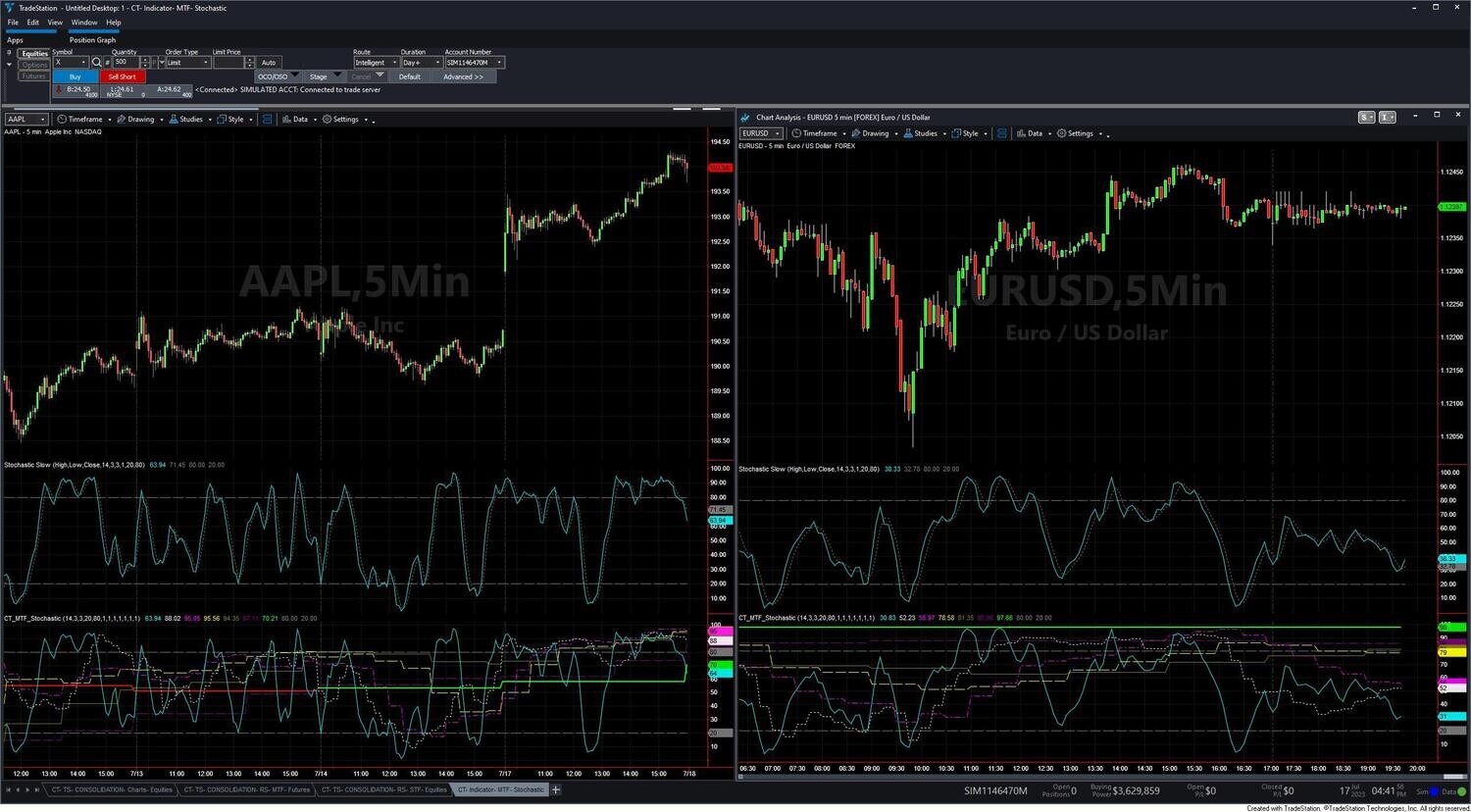
The MTF Stochastic Indicator brings multi-timeframe Slow Stochastic readings onto a single chart. Instead of switching between chart intervals to check where the stochastic stands on the 15-minute, 30-minute, hourly, and higher timeframes, you see all of them simultaneously — each as a separate color-coded line in the indicator's subchart. When multiple timeframes are rising from oversold together, you have structural confirmation. When short-term and long-term readings diverge, you know to stand aside.
The product ships with two indicators that approach multi-timeframe stochastic display differently:
Both indicators calculate a Slow Stochastic (%K) using the standard formula:
Fast %K = (Close − Lowest Low) / (Highest High − Lowest Low) × 100
Fast %K is then smoothed twice — once over Smooth_Length_1 bars to produce Slow %K, and optionally again over Smooth_Length_2 bars for %D. The result is a value between 0 and 100. Values near 0 indicate the close is near the bottom of its recent range (oversold). Values near 100 indicate the close is near the top (overbought). Default inputs: Stoch_Length = 14, Smooth_Length_1 = 3, OverSold = 20, OverBought = 80.
Each line is color-coded by direction: Green when Slow %K is rising from the previous bar, Red when it is falling.
CT_MTF_Stochastic plots up to seven Slow %K lines simultaneously — one for each of the following clock intervals:
| Line | Timeframe |
|---|---|
| Stoch-Chart | Current chart interval |
| Stoch-15 Min | 15 minutes |
| Stoch-30 Min | 30 minutes |
| Stoch-60 Min | 60 minutes |
| Stoch-120Min | 120 minutes |
| Stoch-240Min | 240 minutes |
| Stoch-Daily | Daily |
The indicator automatically suppresses lines that would be redundant on wider chart intervals. For example, the 15-minute line is only visible on 1-, 3-, or 5-minute charts; the daily line is visible on charts up to 240 minutes. This keeps the display clean regardless of which chart interval you are using.
Alerts fire on the current chart-interval line: SlowK crossing up from OverSold and SlowK crossing down from OverBought.
Requires an intraday (minute-based) chart. CT_MTF_Stochastic will raise an error on daily or non-time-based charts. Allow at least 2,000 bars of history before relying on the higher-timeframe lines.
CT_MTF_Stochastic_Multiple builds higher-timeframe bars by grouping a set number of base chart bars, rather than aligning to clock times. This makes multi-timeframe stochastics available on any chart type — including tick, volume, and range bars where clock-based intervals don't apply.
Seven lines are available, labeled 1X through 7X. The 1X line is the base chart. Lines 2X through 7X each close after Multiple_N base bars have completed (defaults: 3 / 6 / 9 / 12 / 15 / 20).
On a 5-minute chart the defaults produce: 2X = 15 min, 3X = 30 min, 4X = 45 min, 5X = 60 min, 6X = 75 min, 7X = 100 min. To match standard clock intervals, simply set the multiples accordingly — on a 5-minute chart: Multiple_2 = 3 (15 min), Multiple_3 = 6 (30 min), Multiple_4 = 12 (60 min).
Lines 2X through 7X require 200 completed higher-timeframe bars before they display, so allow at least one full trading session for all lines to become active.
Multi-timeframe alignment: When all lines are rising and above 50, or all falling and below 50, the trend has directional momentum across timeframes. The most reliable setups occur when a short-term line lifts out of oversold (20) while longer-timeframe lines remain above 50 — a pullback entry within an ongoing uptrend — or when multiple timeframes reach oversold simultaneously, suggesting a more significant reversal zone.
Divergence: Short-term lines at oversold while longer-term lines are still elevated signals a counter-trend bounce opportunity — but the larger trend structure remains intact. These setups require caution and typically benefit from a structural level from the Fractal Channel Indicator to provide the entry reference.
Overbought/oversold caution: A stochastic can remain overbought for an extended period during a strong trend. The OverBought and OverSold levels work best as alert and entry-screening thresholds, not as direct reversal signals by themselves.
What is the difference between CT_MTF_Stochastic and CT_MTF_Stochastic_Multiple?
CT_MTF_Stochastic aligns to fixed clock intervals (15, 30, 60, 120, 240 minutes, and daily). It requires an intraday time-based chart. CT_MTF_Stochastic_Multiple builds higher-timeframe bars from bar-count multiples of your base chart — making it the right choice for tick, volume, or range bars, or any time you want higher timeframes proportional to your bar type rather than fixed to the clock.
Are the timeframes configurable?
CT_MTF_Stochastic uses fixed clock intervals with individual on/off toggles per line — you can hide any line you don't want, but the intervals themselves are fixed. CT_MTF_Stochastic_Multiple has fully configurable multiples via the Multiple_2 through Multiple_7 inputs, so you define what "higher timeframe" means in terms of bar counts.
What do the colors mean?
Green means that timeframe's Slow %K rose from the previous bar. Red means it fell. This makes it easy to see at a glance which timeframes have upward momentum and which are turning lower, without reading the numeric values.
Does this indicator repaint?
No. All calculations are based on confirmed closed bars. Once a bar closes, the Slow %K value is fixed for all timeframes.
How does this work with other indicators in the product line?
A common approach is to use the MTF Stochastic to identify oversold conditions as price approaches a Fractal Channel support level — when the stochastic is oversold on multiple timeframes at a structural support level, the structural and momentum cases for a long setup align. Adding the MTF Price Action Indicator confirms whether the directional bias across timeframes supports the trade direction.
What is your refund policy?
All sales are final. Review our product documentation and the Learning Center before purchasing. If you have a technical issue after purchase, contact [email protected].


Our indicators and trading systems are built by active traders, not software developers — every tool in this library exists because we needed it ourselves. That means each product solves a specific, real-world trading problem: the Fractal Channel Indicator gives you non-repainting support and resistance based on actual price structure, the MTF Price Action Indicator Set eliminates the need to manually correlate multiple charts, and the Risk Reward Indicator automates stop placement and position sizing on every trade.
Every indicator is built around multi-time-frame confirmation — the single most reliable edge available to independent traders. Our MTF suite covers RSI, MACD, ADX, Stochastic, VWAP, Floor Trader Pivots, and Fractal Channel, all displaying multiple time frames simultaneously on a single TradeStation chart. When a signal is confirmed across four, six, or eight time frames at once, the probability of a successful trade improves significantly over any single-time-frame analysis.
Our complete trading systems — the Trend Rider, Scalper Day Trading System, MTF Trend, Counter Trend, and MTF Consolidation Breakout — go beyond individual indicators. Each system combines RadarScreen scanning, multi-time-frame analysis, chart-based execution, and automated exit management into a fully integrated workflow. Your computer does the scanning; you make the trading decisions.
All products are instant digital downloads for TradeStation 10 and later, compatible with any market and any chart type. Every purchase includes a step-by-step installation guide, Learning Center video access, and email support. Future updates to all trading systems are included at no additional cost.