
Fractal Channels • Multiple Time Frame Price Action • Time-Based Volume
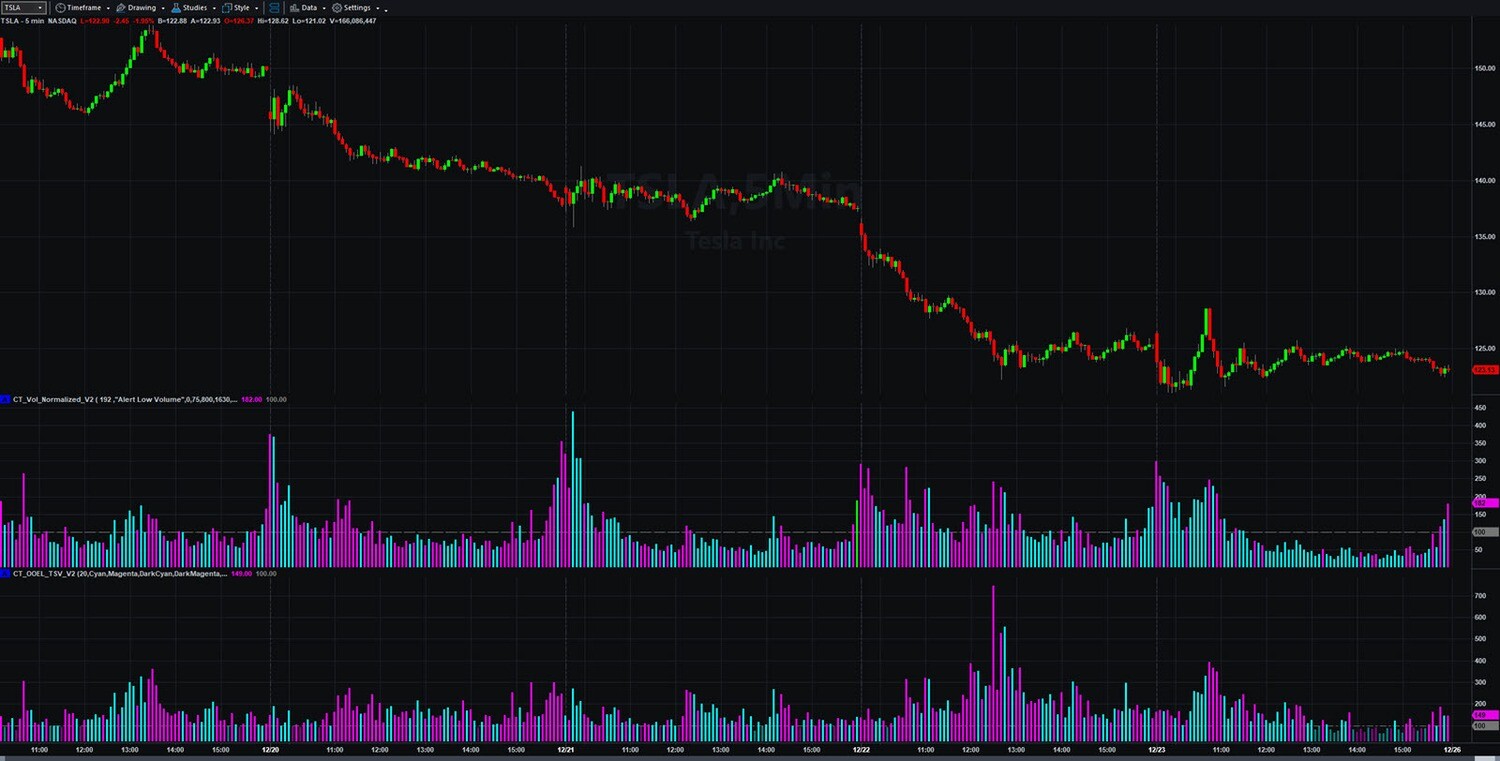
The Time Base Volume Indicator is a two-indicator package that gives you a normalized view of whether current volume is meaningful — expressed as a percentage of a reference value so that 100% always means normal, above 100% is above normal, and below 100% is below normal.
The two indicators use different reference methods suited to different needs:
Most volume indicators compare a bar to a rolling average of recent bars — which blends early-morning high-volume bars with quiet mid-afternoon bars into a single reference. CT_OOEL_TSV takes a different approach: it compares the 9:40 bar specifically to the median 9:40 volume across the past 20 trading days (default). A reading of 150 means the current bar has 50% more volume than the typical bar at that same time of day.
Formula: TimeSegValue = (CurrentBarVolume / MedianVolumeForThisTimeSlot) × 100
Bar colors communicate both volume level and price direction at once:
A high-volume spike alert fires when volume reaches a configurable threshold (default: 600% of the time-slot median). Alert colors are configurable.
Startup delay: The indicator requires N full trading days of data to build its time-slot median tables before it starts plotting. On the default 20-day setting, expect approximately 20 days (plus an additional 14-day buffer for futures and forex) of blank history at the start of the data window. This is expected — the indicator needs a complete reference dataset before producing valid readings.
Best for: Intraday time-based charts where you want to know whether a specific time-of-day bar is truly high or low volume compared to the same time historically.
CT_Vol_Normalized compares each bar's volume to a rolling average of the past N bars (default: 192). It uses the same percentage scale as CT_OOEL_TSV — 100% is average — and adds divergence detection: it flags bars where price moved in one direction but the underlying tick volume (up ticks vs. down ticks) moved in the opposite direction.
Formula: PlotVolume = (CurrentVolume / AverageVolume) × 100
Normal bar colors:
Divergence colors (override normal, require wide bar + volume above 100% + tick imbalance above threshold):
Alerts available: High Volume (default on, fires at 200%), Low Volume (default off, fires below 75% within a configurable time window), End-of-Bar Volume (default on, fires when the prior bar's volume exceeded 600%), and Divergence Up/Down (default on, fires when Green or DarkRed divergence conditions are met).
Best for: Any chart type. Starts plotting after AvgLength bars with no multi-day startup delay. Use when you want quick volume context plus divergence signals.
Add both indicators to the same subchart. CT_OOEL_TSV's time-segmented bars and CT_Vol_Normalized's rolling-average bars tend to align on truly significant volume events, confirming each other. When both show above-100% readings on the same bar, that is a stronger signal than either alone.
CT_Vol_Normalized divergence signals are most useful at structural levels: a Green bar (price up, down-tick dominant) at resistance suggests sellers are absorbing the move. A DarkRed bar (price down, up-tick dominant) at support suggests buyers are stepping in. Use in conjunction with price context, not in isolation.
What are the two indicators and when should I use each?
CT_OOEL_TSV (Time Segmented Volume) compares each bar to the median volume of the same time-of-day across the past N days — best for intraday time-based charts where you want time-of-day-accurate volume context. CT_Vol_Normalized compares each bar to a rolling average and adds tick-volume divergence detection — works on any chart type and starts producing readings immediately after its warmup period. Use both together for confirmation.
Why does CT_OOEL_TSV show no data for the first several weeks?
The indicator needs N full trading days of data to build its time-slot median tables before it can produce valid readings. On the default 20-day setting, plus a 14-day buffer for futures/forex, expect up to 5–7 weeks of blank history at the start of the chart's data window. Once the tables are built, all subsequent bars plot normally.
What does a 150% reading mean?
Both indicators express volume as a percentage of their reference value. A reading of 150 means the current bar's volume is 50% above its reference (time-slot median for CT_OOEL_TSV, rolling average for CT_Vol_Normalized). A reading of 70 means 30% below normal.
What is divergence and why does it matter?
Divergence in CT_Vol_Normalized occurs when price closes in one direction but the underlying tick count (up ticks vs. down ticks) moved the other way. A Green divergence bar — price up but more down ticks — means sellers were active even as price rose, which can signal weakness at a resistance level. A DarkRed bar — price down but more up ticks — means buyers were active even as price fell, which can signal a support level holding beneath the surface.
What lookback period should I use for CT_OOEL_TSV?
The default of 20 days (one month of trading) is a reasonable starting point. Increase to 40–60 days for a more stable reference over volatile periods. The valid range is 20–200 days.
What AvgLength should I use for CT_Vol_Normalized?
The default of 192 bars on a 5-minute chart covers approximately 2.5 trading sessions (6.5 hours × 12 bars/hour = 78 bars per session). Adjust proportionally for different intervals — a 15-minute chart would use around 64 bars for the same coverage.
What is your refund policy?
All sales are final. Review our product documentation and the Learning Center before purchasing. If you have a technical issue after purchase, contact [email protected].


Our indicators and trading systems are built by active traders, not software developers — every tool in this library exists because we needed it ourselves. That means each product solves a specific, real-world trading problem: the Fractal Channel Indicator gives you non-repainting support and resistance based on actual price structure, the MTF Price Action Indicator Set eliminates the need to manually correlate multiple charts, and the Risk Reward Indicator automates stop placement and position sizing on every trade.
Every indicator is built around multi-time-frame confirmation — the single most reliable edge available to independent traders. Our MTF suite covers RSI, MACD, ADX, Stochastic, VWAP, Floor Trader Pivots, and Fractal Channel, all displaying multiple time frames simultaneously on a single TradeStation chart. When a signal is confirmed across four, six, or eight time frames at once, the probability of a successful trade improves significantly over any single-time-frame analysis.
Our complete trading systems — the Trend Rider, Scalper Day Trading System, MTF Trend, Counter Trend, and MTF Consolidation Breakout — go beyond individual indicators. Each system combines RadarScreen scanning, multi-time-frame analysis, chart-based execution, and automated exit management into a fully integrated workflow. Your computer does the scanning; you make the trading decisions.
All products are instant digital downloads for TradeStation 10 and later, compatible with any market and any chart type. Every purchase includes a step-by-step installation guide, Learning Center video access, and email support. Future updates to all trading systems are included at no additional cost.