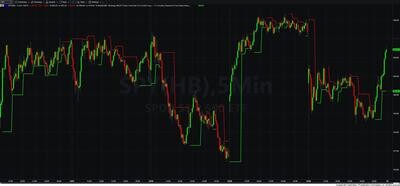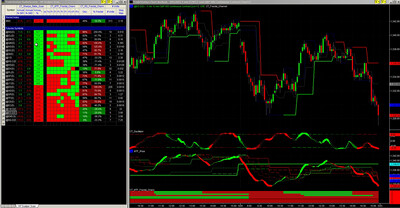

Fractal Channels • Multiple Time Frame Price Action • Time-Based Volume
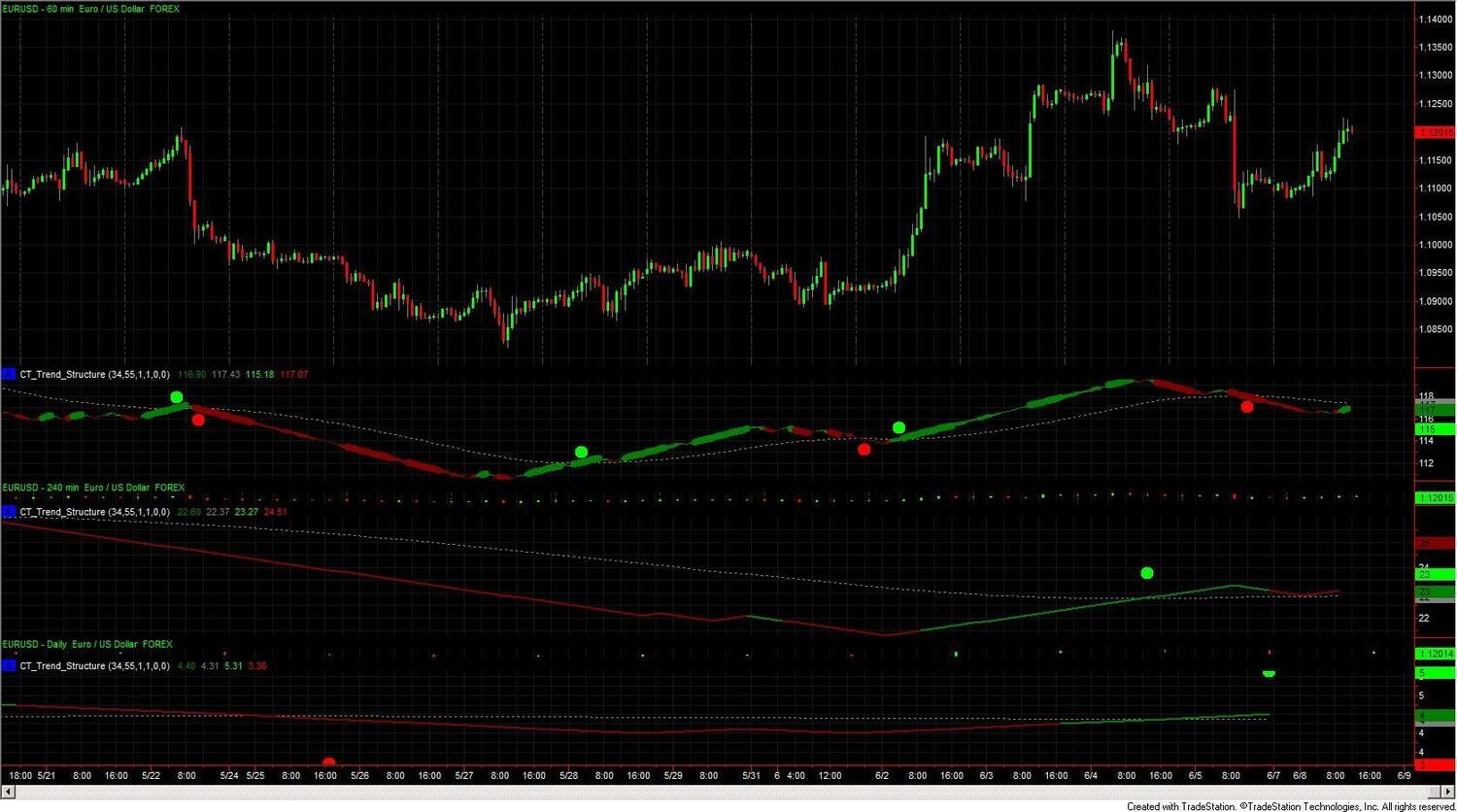
The Trend Structure Indicator measures the underlying directional momentum of the market — not price itself, but the accumulated structure of the price trend over time. It answers the question: is the market building upward momentum, building downward momentum, or consolidating without directional commitment? The answer is displayed as a color-coded oscillator on any chart and, for multi-symbol scanning, across seven timeframes simultaneously in RadarScreen.
The product ships with two indicators:
CT_Trend_Structure plots two lines in a subchart below your price chart:
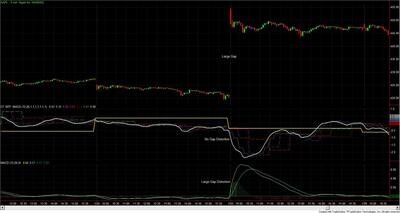
The price engine behind both lines is John Ehlers' Instantaneous Trend (iTrend) algorithm — an adaptive calculation designed to minimize lag by responding to the current frequency of price movement rather than using a fixed lookback like a traditional moving average. All calculations use Adaptive Gapless price, which strips overnight gap distortion from the price series before processing. When price gaps significantly through the moving average at the open, gap removal is temporarily suspended to avoid distorting the reading, then resumes once price normalizes.
CT_Trend_Structure uses three internal systems that each vote on trend direction. Their agreement determines the color and width of the main plot line:
Layer 1 — Instantaneous Trend Direction: The iTrend algorithm tracks whether the smoothed price trend is currently rising or falling — the primary driver of the oscillator's movement.
Layer 2 — Main Line vs. Trigger Line: The position of the main line relative to the trigger defines the current structural bias. Main line above trigger = bullish bias; main line below trigger = bearish bias.
Layer 3 — SP Harmony: Five Super Smoother moving averages at Fibonacci lengths of 13, 21, 34, 55, and 89 bars each independently vote on direction. Their votes are summed into an SP_Dir score from −5 to +5. Positive scores mean all lengths agree the trend is up; negative means agreement that the trend is down. A score near zero means the market is in transition or consolidation.
| Main Line Color | Condition | Meaning |
|---|---|---|
| Green | Above trigger AND iTrend rising AND SP Harmony positive | All three systems bullish — highest conviction long |
| DarkGreen | Above trigger AND iTrend falling | Bullish bias, price momentum fading — potential pause or pullback |
| Red | Below trigger AND iTrend falling AND SP Harmony negative | All three systems bearish — highest conviction short |
| DarkRed | Below trigger AND iTrend rising | Bearish bias, price momentum lifting — potential pause or recovery |
Line width reflects the SP Harmony score — the more of the five Super Smoother lengths voting in agreement, the thicker the line. Width goes from 1 (minimal agreement) to 5 (all five lengths aligned); width of 0 (hidden) when SP Harmony conflicts with the current bias direction.
When enabled, the indicator plots markers on the oscillator for two event types:
Crossover Signals (enabled by default): A green dot when the main line crosses above the trigger (bullish crossover); a red dot when the main line crosses below (bearish crossover). Corresponding audible/pop-up alerts fire simultaneously.
Direction Change Signals (disabled by default): A dark green dot when the indicator detects an upward bias shift after a sustained downtrend; a dark red dot for a downward bias shift after an uptrend. These require at least three consecutive bars of consistent movement in the new direction before triggering — a more conservative confirmation of a trend reversal. Enable them if you want early-warning signals before a full crossover occurs.
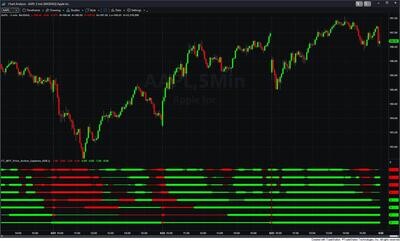
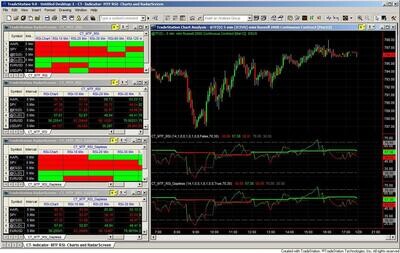
CT_RS_MTF_Trend is a RadarScreen-only indicator that applies the iTrend algorithm across seven timeframes simultaneously for each symbol. Instead of a single trend direction, you see the full multi-timeframe picture in one row:
| Column | Timeframe |
|---|---|
| Column 1 | Current chart interval (e.g., 5 min) |
| Column 2 | 15 minutes |
| Column 3 | 20 minutes |
| Column 4 | 30 minutes |
| Column 5 | 60 minutes |
| Column 6 | 120 minutes |
| Column 7 | 240 minutes |
Each cell is Green when the trigger line is rising on that timeframe (bullish) or Red when the trigger line is falling (bearish). The 120-minute and 240-minute columns require approximately 150 higher-timeframe bars to produce reliable readings — allow one full session before depending on them.
Requires an intraday (minute-based) chart as the data source. CT_RS_MTF_Trend will display a runtime error if applied to a daily or non-intraday chart.
Example multi-timeframe readings:
CT_RS_MTF_Trend also includes an optional consolidation measure — three plots that track how closely grouped the trigger lines are across timeframes. Tightly converged trigger lines signal a compressed, low-range state that often precedes a directional expansion. The Fat Width Alert fires when the SP Harmony score reaches a configurable threshold (default: 3 of 5 lengths in agreement), signaling that momentum conviction is building to a level that often precedes an accelerating trend move.
Use CT_RS_MTF_Trend on your RadarScreen to scan for symbols where multiple timeframes are aligned in the same direction — these are where high-probability setups are most likely to form. Then apply CT_Trend_Structure to the chart of those symbols to confirm that momentum is actively building (oscillator moving away from the trigger) rather than fading (oscillator flattening or reversing toward the trigger).
A crossover alert from CT_Trend_Structure on a symbol that also shows green across multiple CT_RS_MTF_Trend columns is a more structurally supported signal than one where the timeframes are in disagreement.
Is the Trend Structure Indicator included in any of the Trading Systems?
Yes — CT_Trend_Structure is a core component of the Trend Rider Trading System. If you purchase or already own the Trend Rider system, you already have it. This standalone product is for traders who want just the indicator without the full system.
How does this differ from a moving average crossover?
Moving average crossovers measure price relative to an average, which generates frequent false signals in choppy markets. CT_Trend_Structure uses the Ehlers Instantaneous Trend algorithm — an adaptive calculation that minimizes lag by responding to the current frequency of price movement — combined with SP Harmony multi-timeframe agreement scoring. The result is a momentum read that reflects the building or fading of a trend, not just whether price is above or below a fixed average.
What do the colors mean on the oscillator?
Green = all three internal systems bullish (highest conviction long). DarkGreen = bullish bias but momentum fading. Red = all three systems bearish (highest conviction short). DarkRed = bearish bias but momentum lifting. Line width adds a second layer: thicker = more Super Smoother lengths in agreement, thinner = less agreement.
What is the Fat Width Alert on CT_RS_MTF_Trend?
The Fat Width Alert fires when the SP Harmony score reaches the configured threshold (default: 3 of 5 Super Smoother lengths in agreement on direction). This signals that conviction is building — a condition often associated with an accelerating trend. It is most meaningful when it fires after a period of mixed or neutral readings.
Can I use this alongside the MTF Price Action Indicator?
Yes — a common approach is to use CT_RS_MTF_Trend to scan for structurally aligned symbols, use CT_Trend_Structure to confirm momentum is building, and then use the MTF Price Action Indicator to identify pullback entry timing within that trend. The indicators are designed to complement each other directly.
What is your refund policy?
All sales are final. Review our product documentation and the Learning Center before purchasing. If you have a technical issue after purchase, contact [email protected].


Our indicators and trading systems are built by active traders, not software developers — every tool in this library exists because we needed it ourselves. That means each product solves a specific, real-world trading problem: the Fractal Channel Indicator gives you non-repainting support and resistance based on actual price structure, the MTF Price Action Indicator Set eliminates the need to manually correlate multiple charts, and the Risk Reward Indicator automates stop placement and position sizing on every trade.
Every indicator is built around multi-time-frame confirmation — the single most reliable edge available to independent traders. Our MTF suite covers RSI, MACD, ADX, Stochastic, VWAP, Floor Trader Pivots, and Fractal Channel, all displaying multiple time frames simultaneously on a single TradeStation chart. When a signal is confirmed across four, six, or eight time frames at once, the probability of a successful trade improves significantly over any single-time-frame analysis.
Our complete trading systems — the Trend Rider, Scalper Day Trading System, MTF Trend, Counter Trend, and MTF Consolidation Breakout — go beyond individual indicators. Each system combines RadarScreen scanning, multi-time-frame analysis, chart-based execution, and automated exit management into a fully integrated workflow. Your computer does the scanning; you make the trading decisions.
All products are instant digital downloads for TradeStation 10 and later, compatible with any market and any chart type. Every purchase includes a step-by-step installation guide, Learning Center video access, and email support. Future updates to all trading systems are included at no additional cost.